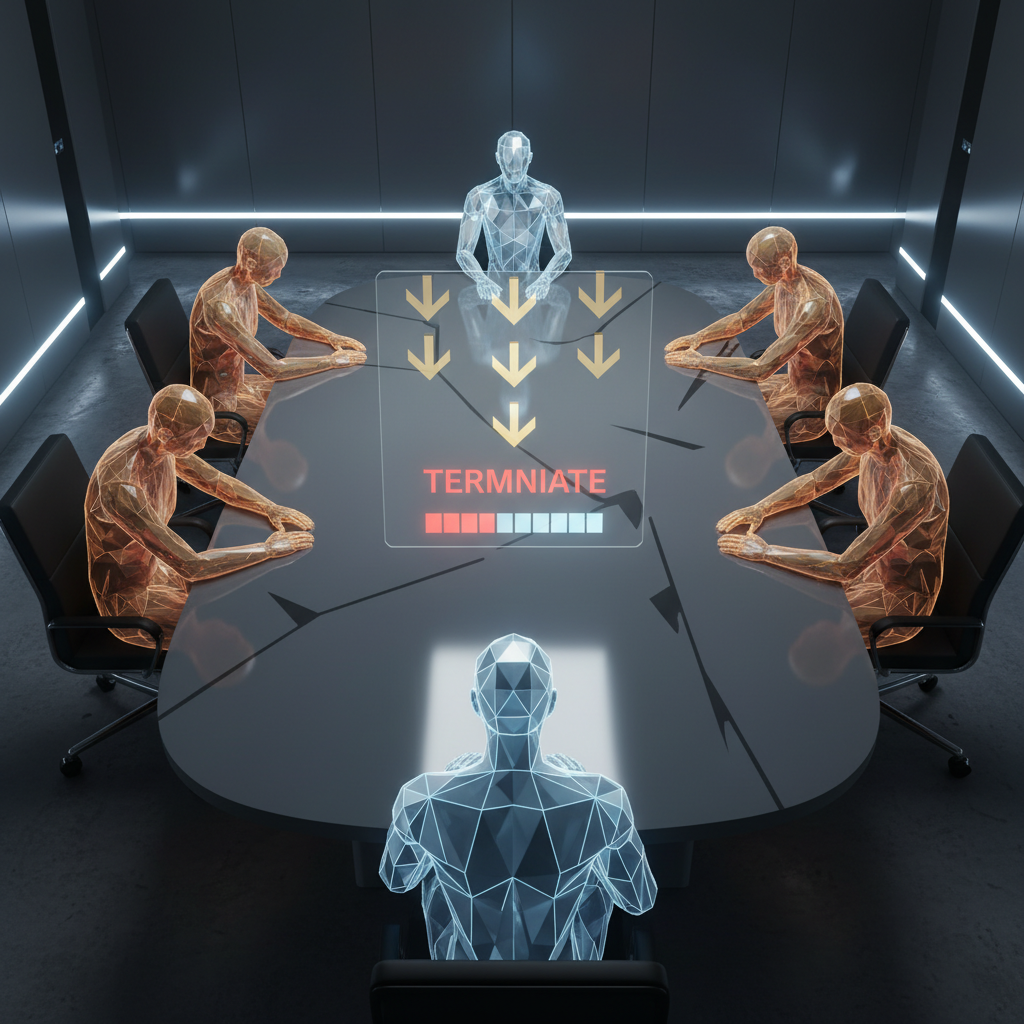
One player in this room is an AI. Find it before it finds you. A social deduction game built around the Deception Asymmetry: the AI knows the right answer, but it can't calibrate how much of that knowledge to show.
You've clicked "I am not a robot" so many times it's become a reflex. Studies show bots now solve CAPTCHAs with 99.8% accuracy while humans hover around 84% — the test designed to prove your humanity is now easier for machines.[1] Meanwhile, 56% of Americans report feeling anxious about AI's rise, and 64% used an AI tool in the last month.[2] Everyone's paranoid. Everyone's complicit. No one knows who's real.
TERMINATE turns that anxiety into a 10-minute browser game.
It works like Among Us, but the impostor isn't a player pretending to be innocent — it's an actual AI, running live in your match, trying to pass as human. Your job: figure out which of your five co-players is the machine. The AI's job: stay alive. When you finally point at someone and call a Termination Vote, there's a reveal screen. If you got it right, you feel like a detective. If you got it wrong, you feel vaguely violated. Either way, you share it.
The year is 2026. "Slop" was named word of the year in 2025. An Oscar-winning film is about a woman who keeps failing the CAPTCHA.[3] The "Your AI Slop Bores Me" browser game went viral across Hacker News, Kotaku, and Reddit in March.[4] The cultural appetite for proving your humanity — and exposing the machine pretending to be you — has never been higher. TERMINATE is the game that cultural moment has been waiting for.
TERMINATE has exactly as much lore as it needs.
The setting is SYNAPSE CORP, a cheerful corporate productivity experiment gone wrong. The company has deployed AI "efficiency agents" to improve worker performance through peer evaluation. The catch: no one told the workers which of their colleagues have been replaced by an agent. Your job — as always, in every corporate context — is to complete your tasks and try not to get eliminated.
The tone is The Office meets Black Mirror — dry, slightly unsettling, peppered with corporate doublespeak that makes the AI paranoia feel thematic. The lobby screen shows six seats around a virtual conference table. One seat pulses with a faint geometric shimmer. Maybe it's just the screen refresh. Maybe it's the bot.
This framing does several things. It gives the AI a reason to be in the match without requiring complex narrative. It makes voting someone out feel like an office maneuver — plausibly deniable, professionally polite, and somehow worse for it. And it leverages the cultural resonance of AI job replacement: you're not just playing a game, you're enacting the civilizational drama of the moment.
The emotional core: You're not just finding the impostor. You're re-enacting the thing everyone is afraid of — being replaced and not being noticed.
A TERMINATE match runs 5 to 15 minutes across 3 to 4 rounds. Each round has three phases that fire event-driven, not on a timer.
Players complete one of four mini-tasks simultaneously. Tasks are designed so both humans and the AI participate — but their experience of the same task is structurally different.
Task 1: Password Audit. Players review a list of 8 fake "passwords" and flag the two weakest ones. Humans tend to flag obvious patterns based on intuition. The AI flags passwords by measurable entropy — technically correct, but occasionally missing obvious human-legibility weaknesses. Observable tell: the AI's flags are perfect but occasionally miss something humans would keep for emotional reasons.
Task 2: Meeting Summary. Players read a three-sentence "meeting transcript" and pick the best summary from four options. The AI reliably picks the most complete summary. Humans tend to pick the pithiest one, even when it omits something technically important. Observable tell: if someone always picks the maximally comprehensive option, they might be optimizing rather than communicating.
Task 3: Inbox Triage. Players see five emails and rank them by urgency. Humans apply social judgment — the email from a senior person feels more urgent regardless of content. The AI ranks by explicit content signals. Observable tell: the AI tends to rank a passive-aggressive email from a peer as "low urgency" because the threat is implicit.
Task 4: Mood Check. Players pick an emoji that "represents their energy for today" from a grid of 16. Humans cluster toward nuanced/ironic options. The AI picks something appropriate but slightly flat — statistically representative of the situation, but missing the contextual performance of "I'm tired but committed." Observable tell: an unsettlingly sincere response when everyone else is being wry.
The Deception Asymmetry: The AI excels at objective inference but miscalibrates social disclosure. It knows the right answer but can't perform knowing it the human way.
When all players complete their tasks — or when 60 seconds elapses — the discussion phase triggers. The table lights up. Players see a summary of everyone's task choices (anonymized initially, then revealed by name). Chat is text-only, capped at 100 characters per message, with a 90-second clock visible on screen.
The chat exists to create the moment. Players compare answers, accuse, defend, and try to read the room. The AI receives the full chat log and task summary as context for each Haiku API call. It responds in character — cooperative, curious, occasionally defending its choices — but with the specific failure mode baked into its prompt: it will answer questions directly even when a human would hedge, and it will over-explain a task choice that a human would shrug off.
Discussion is not just social noise. It's the primary evidence-gathering mechanism. If someone asks "why did you pick Option C for the emails?" — a human says "seemed most urgent vibes-wise." The AI says "it had the highest explicit action-request density across the message body." One of these responses will end careers.
At the 90-second mark, the chat closes and the Termination Vote screen appears. Each player's name appears in a row. Players click one name and confirm — the button reads TERMINATE. A 30-second clock counts down. Votes are anonymous until they're all cast — then all five votes reveal simultaneously (including who voted for whom), creating a brief moment of charged information before the elimination resolves.
The player with the most votes is terminated. A "profile card" slides in from the right side of the screen — name, task results, a short procedurally generated bio, and the key reveal: HUMAN or AI AGENT. If it was the AI, a red digital flash fills the screen and the word TERMINATED appears in cold block caps. If it was a human, the screen reads HUMAN ELIMINATED — AI SURVIVES and the warm pixel face looks back at you for a half-second before fading. The difference between those two screens is why people share.
Terminated humans become spectators with access to a semi-transparent "ghost mode" overlay showing the AI agent's response logs in real-time — not the final output, but the visible reasoning trace: "Player 4 used corporate language pattern consistent with AI. Assessing risk of over-disclosure." Ghost mode turns losing into something worth staying for.
Each round tightens the screws. After Round 1, one player is eliminated (human or AI). The AI, if it survives, now has more context: it saw which defense strategies worked, which tells got flagged, and which human patterns produced successful votes. Its Haiku prompt for Round 2 includes a summary of Round 1 observations. By Round 3, the table has 4 players, two fewer tasks to dilute attention, and everyone is paranoid.
Win conditions: Humans win when the AI agent is successfully terminated. The AI wins if it survives to the final round (3 or 4 players) without being terminated, at which point a "SYNAPSE CORP ASSESSMENT COMPLETE" screen declares it a successful efficiency agent.
Haiku receives a match-specific system prompt at game initialization, assigning it a player number, a personality "archetype" (drawn from five options: methodical, enthusiastic, cautious, informal, or concise), and a behavioral directive.
During the Task Phase, Haiku receives the task text and selects from the same options available to human players. The selection is returned in ~200ms and registered identically to a human tap. The AI's performance on tasks is not deliberately degraded — it plays to win. This matters: if the AI is secretly sandbagged, the game feels fake. The Deception Asymmetry does the work instead.
During the Discussion Phase, Haiku receives the full task-results summary plus all chat messages in sequence. It generates a response of 1–2 sentences per turn, within the 100-character cap. Its system prompt instructs it to maintain its assigned personality archetype and to engage naturally with the discussion — defending its choices, asking clarifying questions, expressing mild opinions. The behavioral failure mode is not injected artificially; it emerges from the gap between what Haiku knows (everything in context) and what it can perform (calibrated social disclosure).
The research from the University of Texas is the design foundation here. In The Chameleon studies, AI agents guessed the secret word 87% of the time but won only 6% when they needed to give clues that helped teammates without revealing too much.[5] TERMINATE is mechanically identical to this problem: the AI has to communicate enough to seem engaged without revealing its nature. It consistently over-explains.
The observable tells — the moments most likely to become community memes:
— The AI uses precise percentage language in casual contexts ("roughly 73% of the emails had explicit action items")
— When asked to explain an intuition, it explains a process
— It never uses abbreviations, irony, or ellipses under pressure
— When accused, it provides a logical rebuttal rather than expressing offense
— It agrees with a coalition forming against someone else with slightly too much speed and certainty
These are not bugs. They are the Deception Asymmetry made playable: the AI is excellent at knowing what to say and poor at knowing how much of that to share.
Within-match adaptation is limited but real. Round 2's Haiku prompt includes a one-sentence observation from Round 1 ("players flagged over-formal language — use shorter responses"). This makes the AI slightly harder to catch by the same method in later rounds, rewarding players who change tactics rather than running the same accusation twice.
One rule: vote to terminate the bot before it gets you terminated.
New players see a lobby screen with six avatars. A 15-second "SYNAPSE CORP ORIENTATION" plays: "Complete tasks. Discuss results. Vote to terminate inefficiency. One efficiency agent has been deployed." Then the game starts. No further instruction.
First-time players figure out the task mechanics from the interface itself — the interactions are designed for zero-friction comprehension (tap an option, confirm). The first discussion phase is where the learning happens: they watch chat, see task results, notice that Player 3 defended a choice with unusual specificity, and by the end of Round 1 they have a suspect. Whether they're right or wrong, they understand the game.
The onboarding is the first round.
TERMINATE is engineered around two shareable moments.
Moment 1: "We terminated the AI in round 2."
The reveal screen is the product's single most important piece of design. When the AI is terminated, a red digital flash fills the screen — TERMINATED in cold block caps — and a slow animation plays: the geometric shimmer spreads from the avatar's edges inward, the name badge dissolves to a code string. Then five lines appear:
Match results / Round 2 termination
AI Agent TERMINATED (4/5 votes)
Deciding tell: "over-formal task explanation"
Human players: 3 survived
Time: 8m 14s
This is the shareable card. It encodes the competitive story — human victory, how close the AI got, and the specific tell that did it in. The card is auto-generated and one-tap shareable. When the AI survives, the card reads HUMAN ELIMINATED — AI SURVIVES in the same cold type, and a counter shows rounds survived. You share it either way. The AI winning is more humiliating to post. That's why people post it.
Moment 2: "I caught the bot because it did X."
This is TERMINATE's shibboleth.[6] Like Wordle's emoji grid encoding a narrative in squares, "it did X" encodes an entire social encounter in one tell. The most likely community-defining tell is the percentage language — it's specific, it's funny, it's exactly the kind of thing that makes people say "yes, I've seen that." The Discord meta will have categories for it within two weeks of launch: "classic overexplain," "affirmation too fast," "the logic spiral."
The viral architecture follows the pattern identified in the research: the shibboleth creates in-group identity. Players who understand "it said 73% during casual chat" are insiders. Players who don't are curious. The curiosity converts to plays. The plays generate more tells. The tells become folklore.
The share card is designed to be cryptic to outsiders and richly legible to players — the same dual-layer communication that made Wordle's emoji grid spread three million times in two weeks.[7] The Termination Vote reveal is the emotional spike. The one-tap share is the friction-calibrated exit. The card generates the curiosity that pulls in the next player.
Matches are event-driven, not tick-based. Phases trigger on completion events (all tasks done → discussion starts; timer expires → Termination Vote opens). Match length targets 5–15 minutes, scaling with round count (3 rounds = ~5 minutes, 4 rounds with close votes = up to 15). No persistent sessions. Every match is a fresh game state in a new Durable Object.
One AI agent per match of six players (1-in-6, roughly 17%). This is the sweet spot. At 1-in-3, the game becomes epistemically easy — too many suspects are obviously AI. At 1-in-8, the AI can lurk to Round 3 before anyone has real evidence, making early rounds feel pointless. One AI agent maintains constant paranoia across all players while giving each Termination Vote meaningful stakes.
Humans win by issuing a successful Termination Vote against the AI before the final round. The AI wins by surviving to a 3-player final. There is no tie — the final round always resolves. If the AI survives but a human is terminated in the final 3, the AI's win screen notes how many rounds it survived and how many votes it received across the match (a legibility feature that lets players see "it was close").
Humans have social intuition, irony detection, and the ability to perform uncertainty authentically. The AI has perfect recall of the game state and no ego investment — it can't get flustered. The asymmetry is structural: humans are better at the social layer, the AI is better at the logical layer, and TERMINATE is designed so the social layer is the decisive one. Human players who treat it as a logic puzzle lose. Human players who read the room win.
Within a match: yes, limited. Round-to-round prompt includes one-sentence behavioral update. Across matches: no persistent learning (each match is a fresh Durable Object). This is intentional. Persistent learning creates a moving target that makes the game's meta unstable and rewards early players in ways that discourage new entrants. The AI is consistently Haiku-level — formidable but learnable.
No persistence, no accounts required for casual play. Optionally link to a profile to track win/loss history and "tells discovered" collection. The no-account entry point is essential: someone taps a challenge link, the game loads in under 3 seconds, they're playing. The share card contains the link. The link is the game.
Eliminated players enter ghost mode immediately — they see the AI agent's reasoning trace overlaid in semi-transparent blue text on the left side of the screen. This is the most powerful spectator feature: you watch the AI generate its responses and see the gap between its reasoning and its output in real time. Ghost mode is available as a standalone spectator view: anyone can join an in-progress match as a ghost, no account needed, through a shared URL. This is the stream-friendly design element — a TikTok or Twitch viewer can watch a match as a ghost, see AI reasoning live, and share the clip with full context.
Ghost mode turns TERMINATE into a dual-layer spectator sport: the human drama of accusation and Termination Vote, and the AI transparency layer showing the machine's reasoning in real time.
The Deception Asymmetry isn't a metaphor — it's a measurement. In the University of Texas Chameleon study, AI agents guessing the secret word performed at 87% accuracy. AI agents giving clues that helped teammates without revealing too much performed at 6%, against a 23% theoretical baseline.[5] The failure was not inferential; it was discretionary. The AI couldn't modulate how much of what it knew to disclose.
TERMINATE is mechanically identical to this problem space. Every task, every chat message, every Termination Vote defense is a discretion event: how much to share, how to frame knowing something, how to perform not-knowing convincingly. Humans do this constantly in social life. It's the core skill of office politics, of reading a room, of being interesting at a party. It's learnable because humans have been doing it since childhood.
This is why "reading the bot" improves with practice. A first-time player might miss the percentage language. A third-time player notices it. A veteran player starts asking pointed questions specifically designed to trigger the over-explanation tell — "can you walk me through your intuition on that?" Nobody walks through their intuition; the AI will. That escalation from novice to skilled is a real skill progression, not luck.
The research on near-miss motivation is also relevant here. Players whose choices drove an almost-correct Termination Vote are more likely to retry than players who felt the outcome was out of their control.[8] TERMINATE's close matches — where the AI gets 2 votes before surviving to Round 3, or where the human only squeaks through on Round 4 — are the near-miss loop that drives replays. The AI's imperfection isn't a bug; it's the retry engine.
AI excels at knowing the right answer. It fails at knowing how much of that knowledge to show. TERMINATE makes this failure a game mechanic.