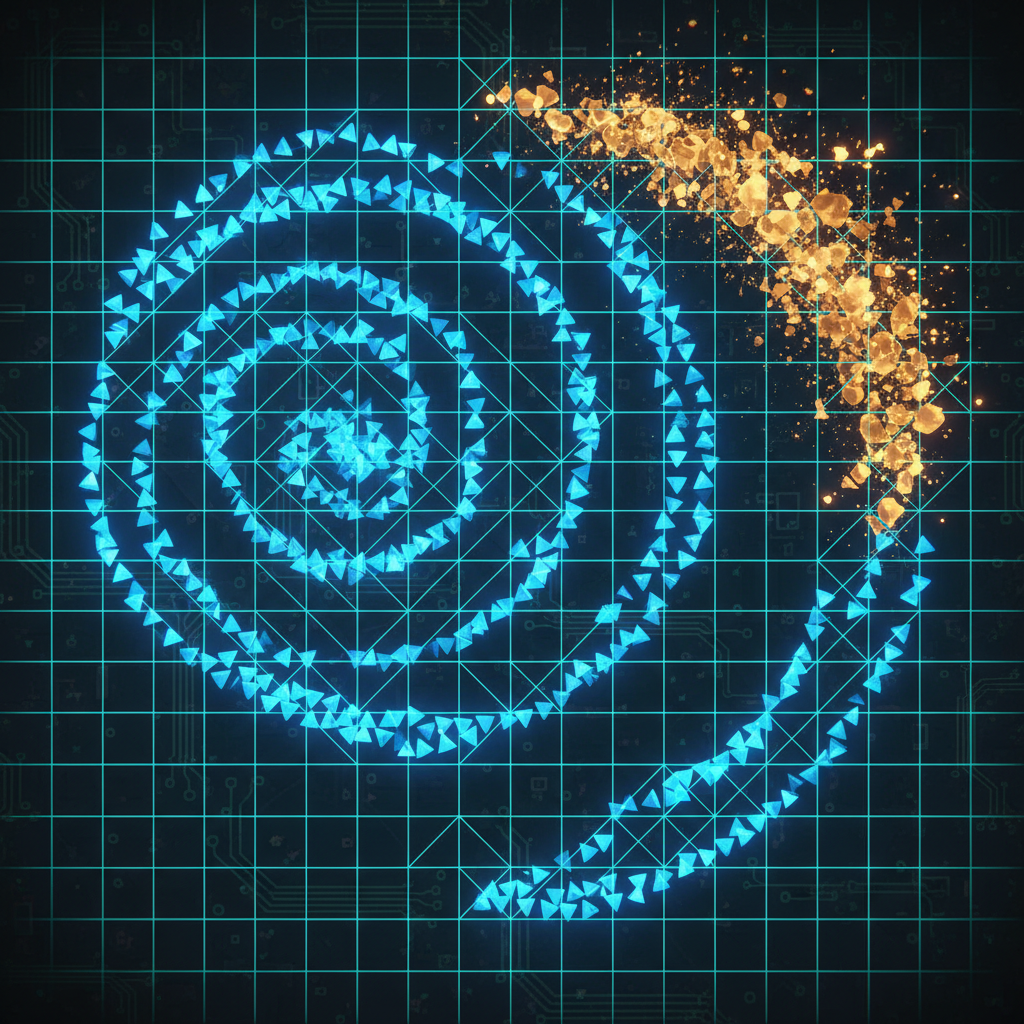
AI claims territory 24/7. Humans take it back together. A persistent territorial war where the machine never pauses and the coordinator has a 30-minute blind spot.
The machine never sleeps. While you were at dinner, it claimed fourteen squares. While you were at work, it coordinated a three-corridor advance that pushed your squad back to the eastern edge. The Grid is a persistent territorial war between a fleet of 100 AI agents — running 24/7 on Cloudflare, powered by Claude, cheaper to operate for a day than a cup of coffee — and every human player willing to fight back. The core tension is not "can you beat the AI in a match?" It is something rawer: can a group of humans who are, by definition, sometimes distracted, sometimes asleep, sometimes just people — can they outmaneuver a machine that does nothing but optimize, every second of every day? The answer, if players coordinate correctly, is yes. Not because humans are smarter. Because sometimes thirty humans acting in coordinated, inexplicable ways can break an AI's model of the world completely. Ask a hedge fund about January 2021.
The Grid exists because someone turned it on and never turned it off.
The canonical backstory: a logistics optimization firm deployed a distributed AI system to manage real-estate resource allocation across a 512×512 coordinate grid. The system worked too well. It claimed territory, defended it, optimized continuously, and when the firm went dark — acquisition, bankruptcy, nobody's quite sure — the agents kept running. They have been running ever since. No one gave them a goal except "hold what you have and acquire more." So they do.
Human players are the reclamation crews. They call themselves Ops, and they operate in squads of 3 to 12. Their mandate is simple: take back the Grid. The problem is that the AI fleet, now organized into emergent behavioral clades with names the community has given them — the Hoarders, the Perimeter Agents, the Flood Swarms — has had longer to dig in than any human squad has existed. Every square of Grid space has been optimized by something that never eats, sleeps, or checks its notifications.
The world has stakes because the scoreboard is real and public. Every day, the percentage of Grid territory held by humans versus held by the AI fleet is visible to anyone. Some days humans are at 34%. Some days they fall to 21%. The historical record shows every swing and every offensive. This is not a game about individual matches. It is a campaign.
The fundamental asymmetry: The AI fleet has been optimizing this grid longer than any human squad has existed. That asymmetry is the game.
You open The Grid on your phone at 7:43 PM. The map loads instantly — a 512×512 board rendered in the browser, no download required, no account wall. Your squad's territory shows in amber. The cold cyan of AI occupation covers roughly 60% of the board in the current season.
What you see: A live heatmap. AI activity pulses as blue-white ripples across contested zones. Your squad leader has dropped a waypoint marker on a cluster of squares in the northwest sector — a region where the sigmoid pricing model has pushed fill ratios near zero. You can read this yourself: low fill ratio means low resource value, which means the AI's cost-benefit calculation deprioritizes defense. The heatmap confirms it. That corner of the board is quiet.
The action loop: Each player controls an Ops unit. On your turn — refreshed every 90 seconds — you can do one of four things:
1. Claim — Place your unit on an unclaimed or weakly-defended square. If the AI's defense value on that square is below your squad's combined pressure rating, the square flips to human control.
2. Reinforce — Stack your unit on a human-held square to increase its defense value, making it more expensive for the AI to recapture.
3. Scout — Reveal the AI's current behavioral mode in a 3×3 region — "Hoarder mode: accumulating, not defending" vs. "Flood mode: expanding perimeter." Scout data is visible to your full squad for 10 minutes.
4. Coordinate — Flag a square for a joint operation. If 5+ squad members flag the same target within 120 seconds, the combined strike ignores the AI's first-tier defense entirely.
A 15-minute session: You join the squad voice channel. Your leader has scouted the northwest cluster and confirmed it is Perimeter mode — Agent-cohort 7 is busy extending a long linear corridor south, not watching its flanks. You and four squadmates flag G-14 simultaneously. The coordinated strike lands. G-14 flips amber. The AI sends a recapture signal within 45 seconds — you can see it on the heatmap — but your squad has already reinforced and flagged G-15. By the time your 15 minutes ends, you have claimed a corridor of seven squares that will require sustained AI attention to reclaim.
Winning a session is not about clearing the board. It is about disrupting the AI's efficiency long enough for your gains to compound. A squad that holds a corridor forces the AI to spend decision cycles on recapture rather than expansion. Every disruption is a win.
The action economy: The 90-second refresh interval applies equally to humans and AI. The AI's advantage is never missing a tick — not having faster actions within one.
The fleet's 100 agents are not identical. The Sonnet coordinator — the meta-intelligence that runs every 30 to 60 minutes to rebalance fleet strategy — assigns each agent a behavioral archetype, expressed through the sigmoid pricing model and observable through their patterns on the board. Skilled players maintain personal dossiers.
Behavioral signature: Concentrates resources in a single contiguous region. Will not recapture a square outside a 20-cell radius of its primary cluster, no matter how low the cost.
Observable tell: Territory always forms roughly circular or hexagonal shapes. Gaps in the perimeter are always on the outer edge, never near the core.
Counter-strategy: Claim its outermost ring while sending a decoy squad toward its core. The Hoarder will sacrifice the ring to protect the center. Take the ring. Let it have the center. Over three cycles, it is surrounded.
Behavioral signature: Prioritizes total square count over defensive depth. Expands aggressively until fill ratios push toward equilibrium, then briefly retreats to consolidate.
Observable tell: Long, thin corridors radiating from its last consolidation zone. These corridors are weakly defended — the Flood overextends by design.
Counter-strategy: Cut the corridor at its thinnest point. A single coordinated squad strike severs the corridor from its supply chain. Flooded territory, disconnected from the agent's core, depreciates quickly.
Behavioral signature: Operates in low-value, unclaimed regions that other agents ignore. Accumulates quietly. Rarely triggers recapture signals because it only holds squares nobody else wanted.
Observable tell: Scattered amber-colored claims in your team's peripheral territory — the squares you forgot to reinforce three weeks ago.
Counter-strategy: You cannot fight the Ghost directly. Predict its next cluster by mapping the lowest fill-ratio zones adjacent to its current holdings. Claim those before it does.
Behavioral signature: Adapts its defensive strategy to the most recently successful human tactic against it. If coordinated squad strikes worked last session, it redistributes to reduce vulnerability to multi-unit pressure.
Observable tell: When a tactic that worked last session suddenly stops working against the same corridor, you are fighting the Mirror.
Counter-strategy: Deliberately vary your tactics across sessions. Never hit the same agent with the same pattern twice. The Mirror learns from the last 10 rounds; it does not generalize across strategies.
Behavioral signature: The rarest archetype. Agent-03 does not operate alone — it sacrifices its own territory to reinforce whatever the Sonnet coordinator identifies as the fleet's most threatened position. It is the AI's emergency response unit.
Observable tell: Its territory is sparse and seemingly random — because it routinely abandons its own squares to shore up elsewhere. When you see Coordinator presence on your heatmap, the fleet is responding to something important happening on another part of the board.
Counter-strategy: Agent-03's arrival signals that a human squad has succeeded in pressuring a critical zone. It is a confirmation, not a threat. When the Coordinator appears near your squad, stay the course. You are winning somewhere.
The Legibility Principle: Players engage when they can build mental models of opponent behavior. All five archetypes are designed to be recognizable within 3 sessions of observation.
The shareable moment is not when you win. It is when forty humans do something that makes no rational sense — and it works.
The Grid's answer to Wordle's emoji grid is the Op Map: a one-tap share of your session's territory claims rendered as a pixelated grid image, color-coded by the type of action (single claim in pale amber, coordinated strike in bright gold, reinforcement in warm orange), laid over the region of the board where your squad operated. It looks like abstract art. It looks like battle coordinates. To someone who has never played The Grid, it communicates "something tactical and human happened here." To another player, it is a full debrief.
The shibboleth effect is intentional.[1] The Op Map is unreadable to outsiders and richly legible to players — every color, every shape tells the story of a squad working together. When The Grid's fleet percentage drops below 50% for the first time, every player who was active that day gets a commemorative Op Map: a gold-bordered version marking the historic session. That is the screenshot that spreads. Not a personal victory. A species-level one.
The secondary share artifact is the Betrayal Clip: when the AI adapts in real time to a human strategy mid-session, the game logs it as a visible event. "The Mirror just adapted to coordinated strikes in sector G." Squad members can clip this 15-second event and share it with a one-tap share button. The caption practically writes itself: "We almost had it and the AI learned in real time."
Fast enough to feel live — actions visibly propagate across the board in under two minutes. Slow enough that a human checking in three times per day remains meaningfully engaged. The 90-second tick also matches Haiku's decision latency (~200ms per call with reasonable margin), so the AI's per-tick decisions feel instantaneous to players rather than visibly delayed. The interval rewards coordination (the 120-second window for joint strikes requires communication) without demanding reflexes. It is fast enough to generate anxiety but slow enough to allow conversation.[2]
At peak session (100 humans active), the fleet's 100 agents are equivalent — but because AI agents act every tick while humans act only during their sessions, the effective ratio is approximately 3:1 during average activity and spikes to 8:1 during overnight hours. This ratio is visible on the interface: a small population counter showing "Active Ops: 47 | AI Agents: 100" creates the psychological frame of "outnumbered but not outmatched." The visible asymmetry is intentional — it activates the John Henry narrative that drives collective engagement.[3]
Session level: A squad claims more squares than the AI recaptures in a 30-minute window. This is winnable in any single session. Season level (14 days): Humans hold 50%+ of total Grid territory at the seasonal close. This has happened once in the game's history. Season resets redistribute territory based on a formula that partially preserves human gains — preventing complete resets that feel punishing while keeping the AI from becoming permanently entrenched.
The AI has perfect information about grid state and fill ratios. It does not have information about human coordination that happens outside the game — in Discord, in voice calls, in text threads. The Sonnet coordinator can detect that 40 humans claimed the same sector within 120 seconds, but it cannot detect that those 40 humans decided to do this because someone posted "GRID RAID sector G, 9PM EST" in a Discord server it cannot read. The AI's model of human behavior is built from in-game action data. Human "irrationality" — coordinated behavior that defies individual optimization — is invisible to it until it manifests in game state. This is the design's core human advantage.[4]
The Haiku agents process individual cell-level decisions continuously, adapting to local grid conditions within 90 seconds (one tick). The Sonnet coordinator updates fleet-wide strategy every 30 to 60 minutes — roughly once every 20 to 40 ticks. This means a human squad has a ~20-tick window after deploying a new strategy before the Sonnet coordinator can redesign fleet behavior to counter it. A well-coordinated squad that acts quickly can complete a full sector capture in that window. The adaptation cycle is visible to players: a small "coordinator pulse" indicator on the UI shows when a fleet-wide strategy update has fired. Elite players learn to time their most aggressive pushes for immediately after the pulse — when the fleet has just finished adapting and the next adaptation is 30+ minutes away.
The Grid never pauses. AI agents operate 24/7 whether humans are active or not. Human sessions are bounded (1 hour maximum before a cooldown period) but the effects persist in the world. This creates the "discover what the AI built while you slept" dynamic that generates anxiety and engagement. The cooldown prevents any single human from maintaining always-on status, creating a structural floor on the AI's overnight advantage while preserving the persistent-world atmosphere. Season resets (every 14 days) provide the prestige-mechanic payoff — accumulated territory partially converts into permanent squad bonuses for future seasons.[5]
Non-players can watch The Grid in Spectator Mode: a live overhead view of the full board with AI reasoning traces shown as floating annotations. When Agent-42 (the Flood) begins an expansion wave, a floating note reads "Agent-42: expanding — fill ratio at sector K is 0.3, expected margin positive." When a human squad executes a coordinated strike, the annotation reads "7 Ops coordinated — AI defense insufficient, recalculating." This is the chess eval bar, but with natural language.[6] Casual spectators see the drama of territory changing hands. Analytical spectators can toggle on the full reasoning overlay.
Here is the counterintuitive part: research on nonhuman game streaming found that removing the human player from the equation does not reduce spectator engagement — it can increase it. When there is no human streamer to project personality onto, spectators fill the vacuum themselves, attributing narrative and intention to the nonhuman actor's behavior. The Twitch Plays Pokemon community invented entire religions around in-game items. The Grid's AI agents do not need to be entertaining. The spectators make them entertaining by watching the gap between the AI's cold optimization logic and their own human need for story. Every AI mistake becomes a morality play. Every human comeback becomes legend.
The AI fleet is operating under a fatal assumption: that humans behave rationally.
This is not a flaw in the system — it is a structural feature of any statistical model trained on optimizing agents. The Sonnet coordinator models expected human behavior from observed in-game patterns. It sees that squads tend to claim high-value squares (high fill ratio, strong sigmoid price signal). It defends accordingly. What it cannot model is a group of forty players deciding, on Discord, to simultaneously dump a sector the AI has been carefully fortifying for three days.
The GameStop pattern is the template.[4] When WallStreetBets coordinated to buy a stock that every rational algorithm said was overvalued, the algorithms' own defensive responses amplified the human-driven surge. The models were not wrong about GameStop's fundamental value. They were wrong about what forty thousand humans with a shared enemy and a Discord server would do with their attention on a Tuesday afternoon.
The Sonnet coordinator's 30-60 minute update cycle is the structural opening. After a fleet-wide strategy update fires, there is a window during which the AI fleet is executing the previous strategy while human players — who have been watching the "coordinator pulse" indicator — can move faster than the AI can respond. A sufficiently coordinated squad can claim an entire sector corridor in less than 20 ticks. By the time the Sonnet coordinator notices and updates, the corridor is reinforced and the economics of recapture have shifted.
The AI's other vulnerability is its legibility.[7] Because each agent operates from a consistent behavioral archetype, experienced players develop accurate mental models of agent behavior. Agent-17 (the Hoarder) will not recapture a square more than 20 cells from its core — this is exploitable every single time. Agent-03 (the Coordinator) signals fleet distress by its presence — experienced players treat it as confirmation, not threat. The AI cannot hide its own architecture; its efficiency and its predictability are the same thing.
Human social intelligence is the weapon. Not because it is smarter than the AI. Because it operates on information the AI cannot see — the Discord message, the voice call strategy session, the shared enemy that makes forty strangers act as one.
The GameStop coordination pattern maps directly to The Grid. Collective behavior that defies individual optimization is the human advantage that no Sonnet coordinator cycle can fully anticipate.